

If you’ve spent any time at all on social media, looking through photos and videos of Scent Detecting dogs at work, you can’t help but have noticed the wide variety of pieces of equipment being worn by the dogs; harnesses, collars, lines or, maybe, nothing at all!
So, what were the factors that guided these handlers choices of equipment? What considerations came into play for you when you selected handling equipment for your own dog? Could you have made different choices that might have improved your dog’s Scent Detecting success? Does the Handling equipment that you select and the way that you use it actually matter?

Well, I’m here to tell you that the equipment that you select and the way that you use it does matter … and to save you having to single-handedly negotiate the often “choppy waters” of other peoples personal opinions and preferences (often with too little reference to any supporting evidence), here is the Scent : Detect : Find Ltd simple take on handling equipment – the Good, the Bad and the downright Ugly.
The Good
The only pieces of handling equipment I recommend for Scent Detecting are a harness and line. Nice and simple!
The Harness
The harness performs a number of functions –
- Acts as a cue to your dog that he’s about to start work – From the earliest moments of training, your dog will be introduced to a specific harness – one that he’ll only wear for Scent Detecting and, as far as possible, is markedly different in style and design from any other harness he may wear for other activities. Over time, and with repeated use, this harness will become associated with Scent Detecting activities and will act as a cue to start work. A cue is defined by Udell, et al (2010) as any stimuli that your dog responds to, by altering his behaviour, in order to obtain rewards. Eventually, other cues your dog will respond to will include the environment (context), a particular word (or short phrase) and the presence of the target odour in the search area. As Anderson (2019) points out, we humans are “biased toward cues that we give deliberately, especially verbal ones. Some of us refer to these as commands, as if they were inviolable. We think of environmental cues as somehow less important or less real. But here’s a hint, the dogs don’t”. In short, your dog’s specific Scent Detecting harness is an important, and invaluable, cue to start working.
- Acts as a secure attachment point for a line when your dog is working in potentially hazardous or sensitive environments – It’s all about safety. The safety of your dog, other people and animals and the environment that you may be searching. There will be occasions when you’ll have to attach a line to your dog and that attachment point should be a well-fitting harness. More on this subject a little later …
- Acts as a cue to your dog that he’s finished working – This is a hugely important consideration and one that’s far too often overlooked. As previously mentioned, when trained, your dog’s cues to start work will include the environment (context), a particular word (or short phrase) and the presence of the target odour in the search area. The target odour is likely to linger in the environment long after your training session, or search, has ended and will continue to cue your dog to work. He needs a very clear alternate cue that his work is finished, his job is done, he’s off-duty now, he can relax. Removing his harness will do just that!
Considerations when selecting a harness for Scent Detecting –
- Design or Style – According to Lafuente, et al (2018), “harnesses are often used as an alternative to neck collars, and are regarded by many as the safer option as they do not restrict the trachea in dogs that pull”. That said, over recent years, there has been an increasingly heated debate regarding the supposed benefits provided, or harms caused, by particular types, or designs, of harness. Although I don’t intend to enter into any in-depth discussion here, I think it’s worth highlighting a few points that you might want to consider. A) “Working and competition dogs are at an increased risk of shoulder pathologies due to repetitive stress sustained by this joint during their working activities of training / competition sessions … it is currently unknown if harnesses have a role on the development of shoulder muscle injury … not all working and performance dogs wear a harness” (Lafuente et al, 2018). B) Even amongst those people who advocate the use of harnesses, there are huge disagreements about the type of harness that is considered best. Harnesses can be broadly categorised into two types. Non-restrictive with a Y-shaped chest strap and Restrictive where a strap comes across the front of the dog’s chest. “The categories are named as such because of the presumed limiting [and presumed injurious] effect on forelimb range of motion by the harness coming across the shoulder or not doing so” (Lafuente et al, 2018). In Lafuente et als 2018 study of 9 dogs, they found a “significant decrease in shoulder extension … with both type of harnesses in comparison with no harness … harnesses do limit shoulder extension, but perhaps not in the way originally anticipated, as results show extension is significantly reduced under the non-restrictive harnesses compared with the restrictive harnesses“. C) Interestingly, in Kiss et als 2018 study, results suggested that wearing a harness did “not influence the dog’s walking kinematics [instead] only the changes of willingly chosen natural walking patterns at different speeds (walk, trot) influence gait kinematics“.
- Deciding factors – Fully cognisant of the literature surrounding the use of harnesses in dogs (including the studies highlighted above), I choose to use harnesses with my own dogs (for walking, tracking and Scent Detecting) and I recommend the use of harnesses for my clients dogs. As stated by Shih et al (2021), although there may be no significant differences between harnesses and collars in terms of potentially stress-related behaviours (eg: tail and ear positions, lip-licking and panting), “harnesses may be a better restraint method, as the force exerted when wearing a harness is distributed over a larger area, while the force exerted on the neck when wearing a neck collar is more localised, increasing the potential for injury, or the exacerbation of existing medical conditions“. My recommendations are that the Scent Detecting harness is, A) Markedly different to any other harness the dog wears at other times, B) Easy to put on and take off, C) Is reasonably light-weight, and D) Fits closely and comfortably against the dog’s body. You may need to spend some time introducing the harness to your dog or finding one that he seems to prefer. Make that time! The only type of harness that I insist is not used for Scent Detecting is a “No-Pull” style. Typically these harnesses have line attachment points on the chest and / or back areas with a girth strap that tightens when the dog pulls. Make no mistake, this is aversive to your dog.
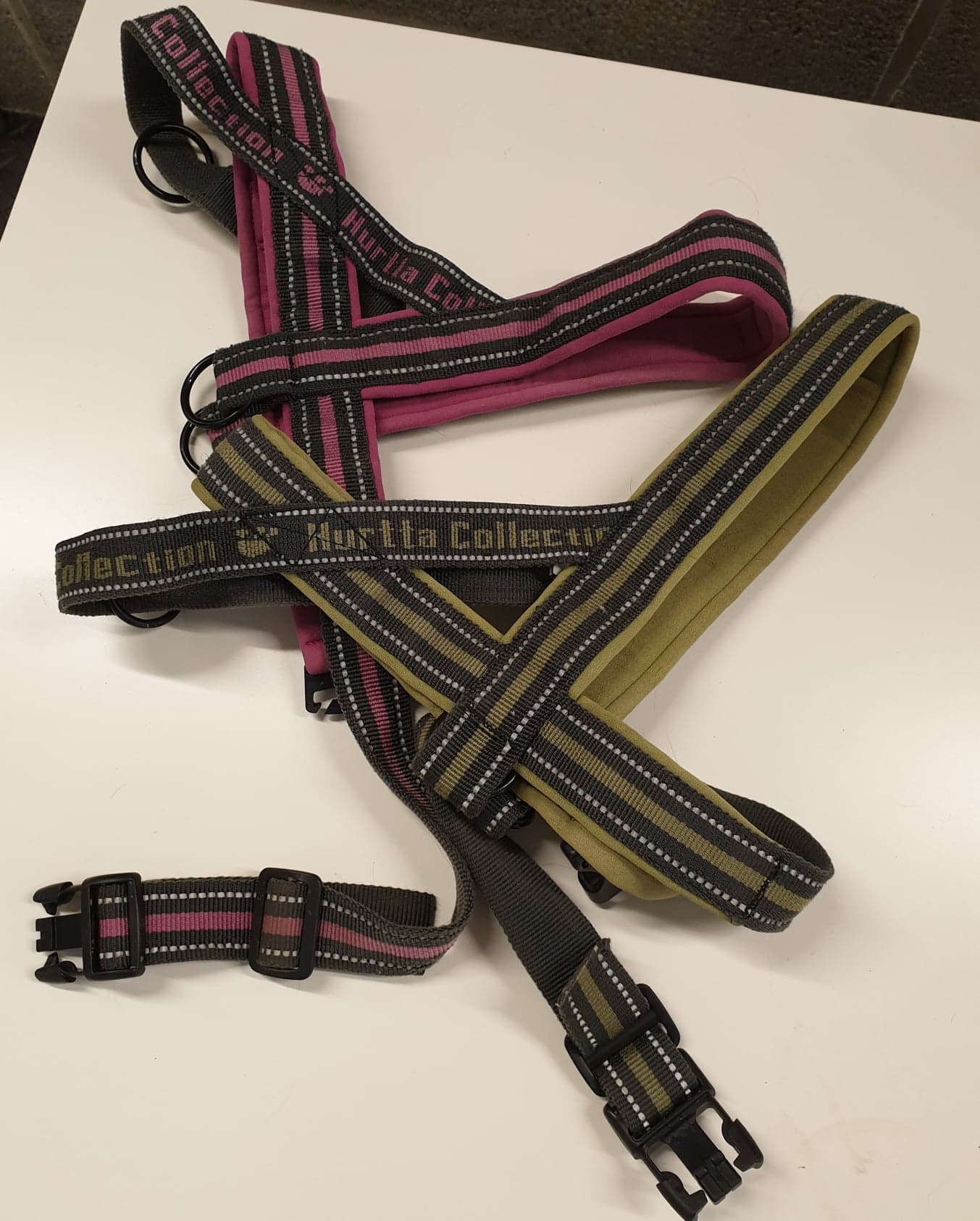
Select a Harness that’s easy to put on and easy to take off again - When a dog has to wear a specific harness for every activity – Very occasionally I come across a dog who, because of a physical disability, has to wear the same harness for all activities. In these circumstances, because the harness is being worn almost continuously, it will no longer act as a cue to the dog to start work or, when removed, act as a cue that work has finished. The solution is reasonably simple. The dog can continue to wear the harness it needs to but, when Scent Detecting, it can wear an additional piece of equipment. In Roo’s case, a little girl with three legs, when Scent Detecting, she wears a specific collar in addition to her harness. When needed, the harness can continue to act as an attachment point for a line but the additional collar acts as a cue to start work and, when removed, a cue to stop.

The Line
This is attached to your dog’s Scent Detecting harness and it’s primary function is safety. It allows you to maintain some physical contact point with your dog whilst he works. I advise my client’s to use what’s commonly referred to as a pony lead-rein. It measures approximately 2m (or 7ft) in length which is just a little longer than a standard dog lead. It’s light-weight and soft to the touch and it’s very affordable – usually far cheaper than an equivalent, standard length, dog-lead.

Whatever line you use, please ensure that it doesn’t have any extra clips or connection-points along its length. These can get caught on obstacles as your dog is searching. Long-lines and Tracking lines are unsuitable for Scent Detecting work – I’ll return to this point a little later.
During initial training with Scent : Detect : Find Ltd, dogs are always worked without a line. This is only possible because of the highly secure training environment that Scent : Detect : Find Ltd can provide and ensures that each dog is given the very necessary freedom to develop his own, independent, search strategies without any undue influence from his handler.
Scent : Detect : Find Ltd is developing Filament Detection Dogs®. That is, Scent Detecting dogs that can work independently of their handlers to detect scent filaments and tendrils in the search environment and follow these back to source. To develop these skills, dogs have to be given an enormous amount of freedom – to work as they choose – from the very earliest stages of their training. To some extent, working without a line helps to mitigate the Clever Hans effect (False Indications, Clever Hans and You) whilst developing the skills of a Filament Detection Dog®.
The concept of independent working has to be firmly established in both the dog and their handler before a line is attached to the harness. There seems to be a huge misunderstanding regarding the use of lines and the notion of independent versus directed working. To be clear, a dog can work as independently when he’s attached to a line as when he’s not. What matters here is how the line is being used by the handler – line handling skills. The line is simply there as a means of keeping everyone safe. It should not be used to pull the dog into different search areas or prevent him from moving into areas of his choice.
As a final point, lines should NEVER be attached to a flat collar, head collar, slip lead, check or prong collar. More on this in the following sections.
The Bad
Flat Collar
Because, more often than not, the flat collar is where the dog’s (legally required) identity disc is attached, the majority of handler’s will work their dog while he’s still wearing his collar … and I include myself here! This is not a problem unless you have a dog who becomes anxious or frightened if his collar catches on, or his identity disc rattles against, an object. Typically this will happen when the dog attempts to push his head inside something – a box – while he’s searching. If you know that this may be an issue for your dog, remove his collar before you start work.
While I have no objection to your dog wearing his collar while he works, I do consider it bad practice to attach a line to it. As Hunter et al (2019) very clearly state, “due to the natural instinct of the dog to pull against the pressure exerted from a neck restraint, inappropriate choice and use can have welfare consequences for the animal with the potential to cause nerve damage or temporary upper airway obstruction. Pressure exerted on the neck may also aggravate certain conditions of the eyes or be detrimental to certain breeds such as brachiocephalic breeds. The higher the collar sits on the neck the greater the risk of damage“.
Not only do I no longer walk my dogs on flat collars because of concerns for their physical well-being, neither do I work my dogs with a line attached to their flat collars. I think it’s worth highlighting that last sentence of Hunter et als (2019) quote – “The higher the collar sits on the neck the greater the risk of damage“.
I don’t think that it’s unreasonable to suggest that, if you have a dog who pulls on his collar and lead when you’re out for a walk then it’s highly likely that his collar will be sitting high on his neck. Similarly, while Scent Detecting, if you attach a line to your dog’s collar and your dog is working with any degree of enthusiasm, his collar will be sitting high on his neck. Not even the most skilled handler has the ability to prevent this from happening. The simple solution – don’t attach a line to your Scent Detecting dog’s flat collar.
Interestingly, if you believe that your particular collar is problem free, consider this. “Collar construction material will alter contact pressure and peak force exerted on the neck … a double layer nylon neck collar with ethylene-vinyl acetate cushioning has a higher contact pressure than either a single layer nylon or canvas construction, which may be contrary to an owners expectations when purchasing a collar” (Hunter et al, 2019).
Extra-long Tracking or Trailing Line
If you’re currently using a tracking or trailing line for Scent Detecting, think again. At anything between 6m and 30m in length (dependent on which line you purchase) tracking lines can be highly problematic when used to their full extent. To illustrate my point, here are a few questions you might like to consider –
- Can you actually see what your dog is doing when he’s working at the full extent of his line? If not, your line is too long.
- Could you miss your dog’s indication at the distance he is away from you? If so, your line is too long.
- Could your line become tangled around obstacles eg; trees and undergrowth, because it’s trailing on the ground? If so, your line is too long.
- Do you, pretty routinely, find yourself carrying the majority of the line in a hank? If so, your line is too long.
- Have you, or your dog, ever become tangled in the line? If so, your line is too long.
I could go on … but my message is clear … a long-line requires considerable expertise if it is to be used safely. The development of this expertise takes time, and practice, and injuries to both you and your dog can still occur.
And NO, contrary to what has been suggested to me over recent months, my preference for a shorter, more manageable, Scent Detecting line, does not mean that my dog’s independent searching is compromised. When wearing a line, a Filament Detection Dog® is still in control of the search. He may be connected to his handler by the line but, importantly, the handler is led by, and follows, the dog. The line is not used to control and direct the dog.
What a shorter, more manageable, line does equate with is safer searching. A long line provides no benefits for the Scent Detecting team and, in practice, can prove highly dangerous when used improperly.
The downright Ugly
… and in no particular order.
I do not allow any of these pieces of equipment, or handling techniques, at any Scent : Detect : Find Ltd course or event.
Prong Collar
A prong collar is an aversive. It’s something that your dog doesn’t like. As Anderson (2021) states, it’s “very simple. Prong collars hurt dogs. They hurt a lot, depending on how tightly they are fastened and the handler’s behavior. Sometimes the sensation may be as low as mild discomfort. But make no mistake: if wearing a prong collar gets your dog to stop pulling on the leash, it’s because it becomes uncomfortable to do so”.
And, yes, prong collars are used by some handlers while Scent Detecting with their dog. Problems include –
- The development of an association between Scent Detecting and discomfort. Scent Detecting activities are frequently cited as offering numerous behavioural benefits for the the dog. These potential benefits are soon cancelled out by the use of this piece of aversive handling equipment.
- Reluctance of the dog to move freely around the search area in an effort to avoid pain. This will result in a limited and, potentially, unsuccessful, search.
Check Collar and Slip Leads
I don’t consider there to be any significant differences between check/choke collars and slip leads. While check collars are made of metal links, and slip leads made of rope, leather or other fabric, both are worn around the dog’s neck and will tighten as the dog moves away from their handler. The resultant effect is an increasing pressure around the dog’s neck.
Whilst “all collar types have the potential to cause injury” (Carter et al, 2020), a collar with “a smaller contact area minimises pressure distribution and concentrates the force on a smaller area [and] is more likely to have a higher risk of injury. The lurcher collar provides a much larger area for the distribution of force compared to the rope slip lead and check chain” (Carter et al, 2020).
Once again, when these pieces of handling equipment are used for Scent Detecting, potential problems will include –
- The development of an association between Scent Detecting and discomfort. Scent Detecting activities are frequently cited as offering numerous behavioural benefits for the the dog. These potential benefits are soon cancelled out by the use of this piece of aversive handling equipment.
- Reluctance of the dog to move freely around the search area in an effort to avoid tightening of the check collar or slip lead. This will result in a limited and, potentially, unsuccessful, search.
Headcollar
Shih et al (2021) found that “dogs more frequently pawed at their noses and lowered their heads and ears when wearing headcollars“. These types of behaviour were also noted by Haug et al (2012) who divided behaviours into two groups. “Group 1 included pawing, pawing nose, biting/pawing leash, opening mouth. rubbing face and shaking head. Group 2 included rearing up, balking, rushing forward, and rolling on the ground“.
In addition, “when the dog tries to pull, the halter pull’s the dog’s head downward and to the side, which could potentially cause a neck injury” (Kretzer, 2012).
And, yes, headcollars are used by some handlers when Scent Detecting with their dog. Problems include –
- Obvious discomfort as evidenced by the dog’s attempts to “remove” the headcollar. Any potential behavioural benefits of Scent Detecting are soon cancelled out by the use of this piece of aversive handling equipment.
- The dog’s head and, importantly, his nose are pulled away from the target odour. This can occur both during the search and when the dog approaches the scent source to make his find. It’s completely counter-productive to the Scent Detecting process.
Line running between legs
Social media provides many photographic and video examples of dogs Scent Detecting with a line attached to their collar and running down between their legs and exiting either in front of or between their back legs.
Sometimes this is accidental and the problem lies firmly at the door of a combination of poor handling skills and a line that is far too long to use safely. The excess line trails on the floor and becomes tangled around the dog’s body.
On other occasions, running the line between the dog’s legs is a deliberate and planned technique. It is used to slow the dog down and, yes, you guessed it, the technique achieves this by affecting the dog’s gait and causing discomfort – belly, under-arm area, testicles, vulva, tail. Sadly, on occasion, this can also lead to physical injuries to the dog.
Solution –
- Use a far shorter line. Less line = Less chance that it’ll become tangled around the dog.
- Spend time developing your line-handling skills. At a bare minimum, consider the safety of everyone, and everything, that might become tangled in a poorly handled line.
- Stop relying on aversive techniques to train the Scent Detecting dog. Return to the development of rock solid foundational skills that promote calm, thoughtful, searching behaviour.
So … in conclusion …
Choose your handling equipment with care and use it with consideration and skill. Your Scent Detecting will be more successful and your dog will thank you for it.
Final Note
As with all blogs, I include a reference list. This allows you to investigate the topic a little further, check out the sources of my information and decide for yourself whether my interpretations of the literature represent an accurate reflection of the author’s original work. Happy reading.
© Lesley McAllister – Scent : Detect : Find Ltd 2021
https://www.facebook.com/scentdetectfind/?ref=bookmarks
References / Further Reading
- Anderson E (2017) Why Prong Collars Hurt. Eileenanddogs. What my dogs teach me https://eileenanddogs.co/blog/2017/08/10/why-prong-collars-hurt/ accessed; 6.10.2021
- Anderson E (2019) Oops! I Trained the Better Than Perfect Recall. Eileenanddogs. What my dogs teach me https://eileenanddogs.com/blog/2019/02/19/teaching-dog-recall/ accessed; 18.5.2019
- Anderson E (2021) Questions to Ask About That Bizarre Prong Collar Diagram. Eileenanddogs. What my dogs teach me https://eileenanddogs.com/blog/2021/10/06/questions-about-bizarre-prong-collar-diagram/ accessed; 6.10.2021
- Carter AJ, Roshier AL, McNally DS (2020) Canine collars: an investigation of collar type and the forces applied to a simulated neck model Veterinary Record 187.7
- Haug LI, Beaver BV, Longnecker MT (2002) Comparison of dogs’ reactions to four different headcollars Applied Animal Behaviour Science 79.2 53-61
- Hunter A, Blake S, Ferro De Godoy R (2019) Pressure and force on the canine neck when exercised using a collar and leash Veterinary and Animal Science 8. 1-7
- Kiss R, Nagymate G, Biksi O (2018) Biomechanical analysis of the kinematics of different dog harnesses – Research report Budapest: Cooperation Research Center for Biomechanics. Budapest University of Technology and Economics.
- Kretzer M (2012) Hey, Stop Choking That Dog Animals Are Not Ours https://www.peta.org/blog/hey-stop-choking-dog/ accessed; 6.10.2021
- Lafuente MP, Provis L, Schmalz EA (2018) Effects of restrictive and non-restrictive harnesses on shoulder extension in dogs at walk and trot. Veterinary Record Nov. 1-7
- Shih HY, Phillips CJC, Mills DS, Yang Y, Georgiou F, Paterson MBA (2021) Dog Pulling on the Leash: Effects of Restraint by a Neck Collar Vs. a Chest Harness Frontiers in Veterinary Science 8. 1-9
- Udell MAR, Dorey NR, Wynne CDL (2010) What did domestication do to dogs? A new account of dogs’ sensitivity to human actions. Biological Reviews 85. 327-345


 Scent : Detect : Find